NREGA Official Website & Portal Login
The Mahatma Gandhi National Rural Employment Guarantee Act (MGNREGA) is one of the world’s largest social security programs, designed to guarantee a basic livelihood for rural households across India. By providing at least 100 days of guaranteed wage employment in a financial year to every household whose adult members volunteer to do unskilled manual work, the scheme has transformed the rural economy. In this detailed guide, we walk you through accessing official directories, verifying your profile online, and understanding recent transitions to modernized frameworks.
To access NREGA services, check details, or download lists, the official portal at nrega.nic.in serves as the primary gateway. However, navigating the site’s extensive options can sometimes feel complicated. Below, we break down the login procedures, explain step-by-step how to find your village’s registration logs, and clarify how state codes are structured in the national database.
Check all details about NREGA 2026 here. India’s largest rural jobs program, NREGA the Mahatma Gandhi National Rural Employment Guarantee Act legally guarantees paid wage work to every rural household willing to do unskilled manual labor. In 2026-27, that guarantee has been extended to 125 days under the new VB-G RAM G Act, 2025.
This guide covers everything you need to know: how to check your name in the employment register list, download your job card, track your attendance, and verify your payment status all in plain, simple language.
The official portal serves two distinct audiences. The workers section requires no login and allows public access to check job card lists, attendance records, and payment status. The officials portal is for Panchayat, Block, and State administrators to manage records and process fund transfer orders. Only authorized government staff with registered credentials can log in to the administrative portal.
[Hide]
- 1.NREGA Official Website and Portal Login
- 2.State-Wise List and Gram Panchayat Details
- 3.From MGNREGA to the New VB-G RAM G Act
- 4.How the NREGA Rural Employment System Works Today
- 5.4 Priority Types of Permissible Work
- 6.Wages, Attendance, and Payment System
- 7.MIS Reports: How to Access Them Online
- 8.Start Exploring Your NREGA Rural Employment Rights
- 9.Frequently Asked Questions
- 125 days of guaranteed paid employment
- Direct bank transfer of wages within 15 days
- Work allocated within 5 km of your village
- Unemployment allowance if work is denied
- Worksite facilities: water, shade, first aid
- Minimum 1/3rd participation reserved for women
- Water conservation and check dams
- Land development on SC/ST and BPL farms
- Rural road construction and maintenance
- Afforestation and plantation drives
- Drought proofing and flood control works
- Farm ponds and irrigation canal construction
💡 Official Portal: To access your NREGA job card list, payment status, or MIS reports directly, visit the official government portal at nrega.nic.in. Our guides below make navigating it extremely simple.
Guides to NREGA Online Services (Quick Links)
NREGA State-Wise List & Gram Panchayat Details
Your NREGA Job Card is the most important document under this scheme. It is your identity proof, your work record, and your wage tracker all in one document.
To get your NREGA job card, follow these steps:
- Visit your local Gram Panchayat office (no fees required)
- Fill out the registration form for your household
- Submit one of: Aadhaar Card, Voter ID, or Ration Card
- The Panchayat must issue your card within 15 days
- Registration is per household all adult members can demand work
- Note: Old NREGA Job Cards are valid until Dec 31, 2026. After that, they will be replaced by the new Gramin Rozgar Guarantee Card.
⚠️ Critical: The name on your NREGA job card must match your bank account name exactly. Even a minor spelling difference causes wage payment failures.
Once you receive your card, check all details carefully. If you lose it, you can apply for a duplicate at the same Gram Panchayat office free of charge.
How to Check Your Name in the NREGA List (Step-by-Step Guide)
Follow these 5 simple steps to verify your Gram Panchayat register details online:
- 1Open the Official Portal: Visit nrega.nic.in or select your state from our directory below.
- 2Access Reports: Navigate to “Gram Panchayat” section and enter the Captcha code.
- 3Select Your Location: Choose Financial Year 2026-27, then your District, Block, and Gram Panchayat.
- 4Open the Employment Register: Click “R1. Job Card/Employment Register” to load the full list.
- 5Search Your Name: Use Ctrl+F or “Find in Page” on mobile to search your name instantly.
From MGNREGA to the New VB-G RAM G Act (The 125-Day Rule)
The most critical update for rural workers in 2026 is the increase in guaranteed employment. Under the new statutory framework, the government guarantees 125 days of wage employment per financial year to eligible rural households, up from the previous 100-day limit.
The system also adjusts its operations during peak farming seasons. It implements a 60-day statutory agricultural pause during major sowing and harvesting periods. This pause ensures that local agricultural labor is available for crop production and prevents labor shortages on farms, while preserving your 125-day guarantee for the rest of the year.
Additionally, the funding structure for wage costs is now a strict cooperative model. For most states, it is a 60:40 split, with the Central Government providing 60% of the funds and the State Government providing 40%. North-Eastern and Himalayan states follow a 90:10 funding split.
How the NREGA Rural Employment System Works Today
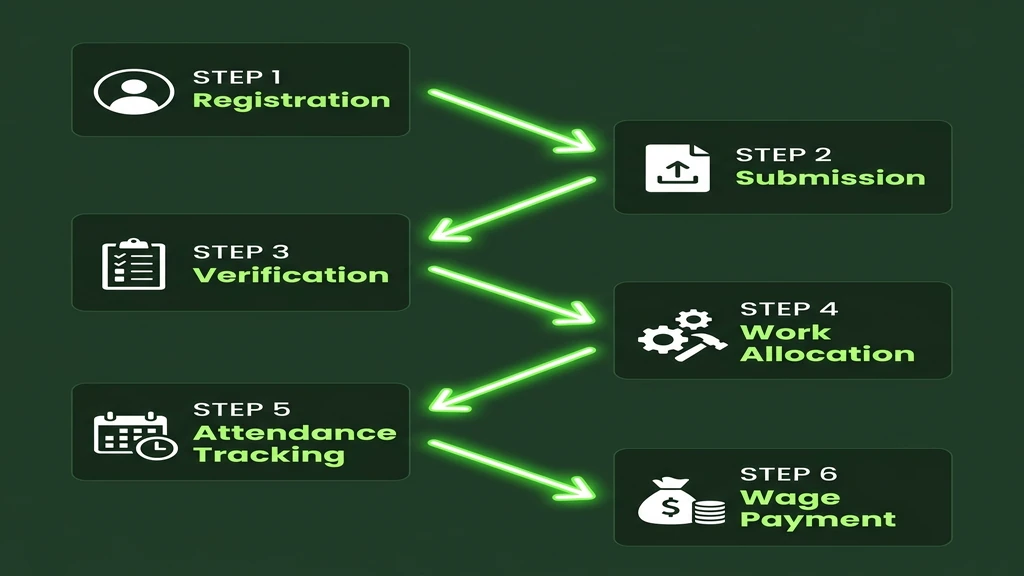
The NREGA scheme runs on a demand-driven model. You request work and the local government must provide it within 15 days, or you will be legally entitled to receive a daily unemployment allowance. Here is the complete process from application to wages:
Common Grievances and Who to Contact
- Job card refused: Gram Panchayat head
- Work not given in 15 days: Block Programme Officer
- Attendance not marked correctly: Gram Rozgar Sahayak
- Wages delayed beyond 15 days: District Programme Coordinator
- Unresolved complaints: District Ombudsman
How to File a Complaint
- Submit in writing, verbally, or via state online portal
- You receive a unique complaint tracking number
- Complaints must be resolved within 7 to 15 working days
- Ombudsman can conduct independent site visits
- Escalate to the state helpline if unresolved
Social audits are the most powerful community tool available. Every Gram Panchayat must hold a public Gram Sabha where all project costs, wages paid, and materials used are read aloud in the local language. As a worker, you can challenge wrong entries on the spot.
4 Priority Types of Permissible Work
Scheme funds may only be used for government-approved work categories. These projects are specifically chosen to create lasting village infrastructure while generating maximum local employment.
Water Conservation and Natural Resource Management
The highest priority category. Works include check dams, percolation tanks, deepening of community ponds, and watershed management. Completed projects raise the local groundwater level, allowing farmers to grow two to three crops per year instead of one.
Land Development for Marginal Farmers
Government funds improve farm land belonging to SC, ST, and BPL households through land leveling, bunding, and soil improvement. These works directly increase crop yield and reduce dependence on monsoon rainfall for smallholder families.
Rural Road Connectivity
All-weather roads connecting remote villages to markets, schools, and hospitals are constructed under this program. Better roads give farmers faster access to larger markets, reducing post-harvest losses from delayed transportation.
Agriculture Support and Horticulture
Farm pond construction, irrigation canals, and large-scale plantation drives on community wasteland. These afforestation projects improve local micro-climate, combat soil erosion, and create long-term income through timber and fruit-bearing trees.
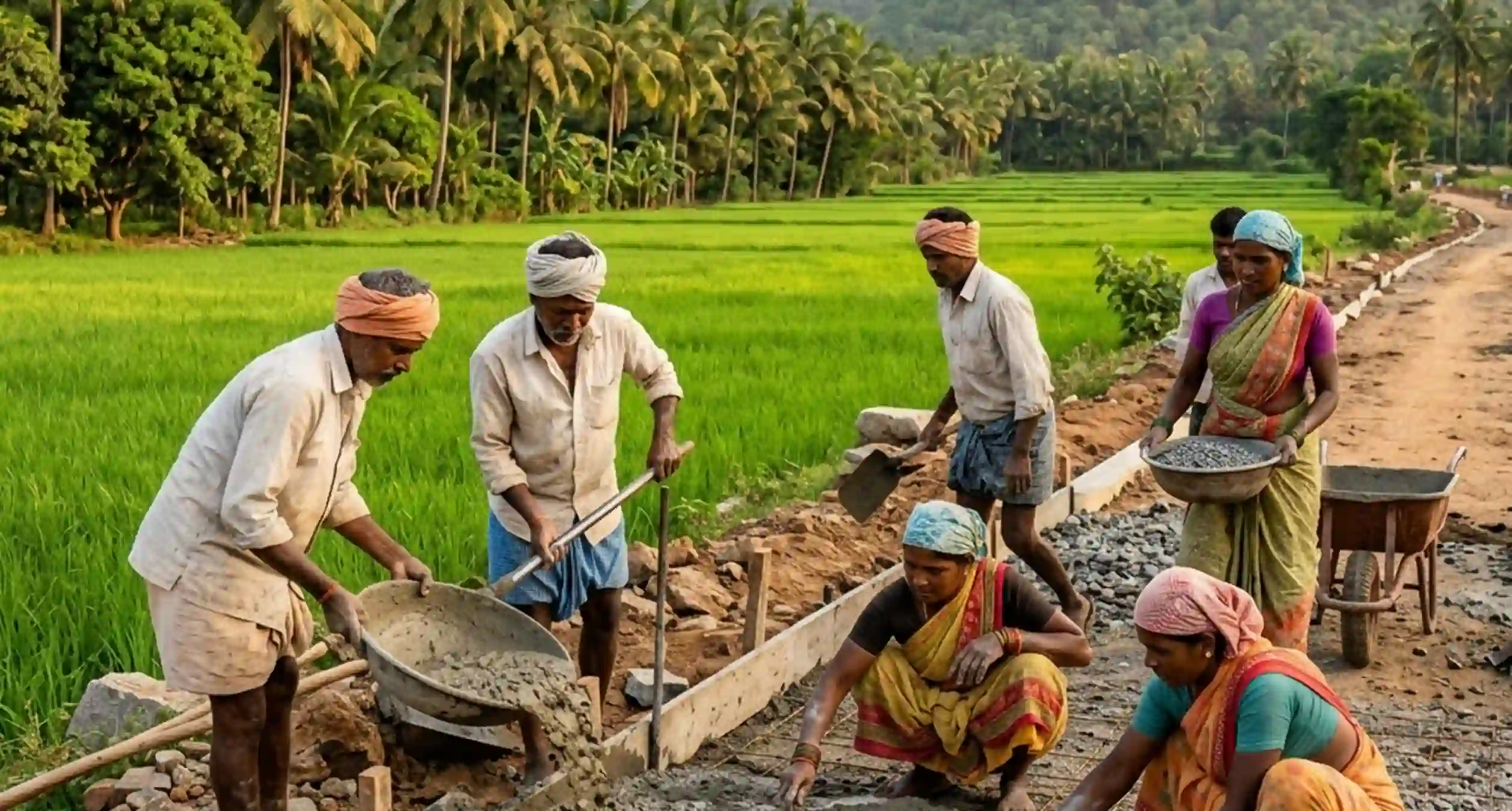
💡 The assets created by these workers form the backbone of sustainable rural development. Every check dam built, every road laid, and every tree planted generates returns for the village for decades to come.
NREGA Wages, Attendance, and Payment System
Understanding how your attendance connects to your wage payment is critical. Since 2023, paper muster rolls have been replaced by the National Mobile Monitoring System (NMMS) app across India.
What NMMS attendance means for your daily wages:
- Your supervisor must take geo-tagged photos of you at the worksite twice a day
- Missing either photo session means your attendance is not recorded for that day
- Unrecorded attendance means zero wages for that day with no exceptions
- If the NMMS app fails due to network issues, the supervisor must maintain a manual muster roll as backup
- Always confirm with your Gram Rozgar Sahayak that your NREGA attendance is logged each evening
⚠️ Check Your Attendance Weekly: Do not wait until payday to discover missing attendance. Use the official NREGA MIS portal to verify your records while the muster roll is still open and correctable.
Payment Status Check Online & FTO Process
Your NREGA wages travel through 4 stages before reaching your bank account:
- Muster Roll Closed: Gram Panchayat calculates your total days and generates the wage list
- Wage List Verified: Block-level officer cross-checks the list and creates the Fund Transfer Order (FTO)
- State Fund Release: State Employment Guarantee Fund approves the FTO and instructs the bank
- Bank Credit: Wages are deposited directly into your Aadhaar-linked account
If your payment shows “processed” but has not arrived, the issue is almost always at the bank level. Common causes include:
- Dormant or inactive bank account (must show activity every 6 months)
- Name mismatch between NREGA job card and bank records
- Aadhaar not seeded (linked) to the bank account
- KYC documents not updated at the branch
⚠️ Your Legal Right: If NREGA wages are not paid within 15 days of the muster roll closing, you are legally entitled to a delay compensation allowance. Report delayed payments immediately to the Block Programme Officer.
Understanding Your State Wage Rates
NREGA daily wage rates differ across India and are revised every April by the central government based on the Consumer Price Index for Agricultural Labourers (CPI-AL).
| State | Daily Wage Rate 2026-27 |
|---|---|
| Haryana | ₹374 |
| Karnataka | ₹349 |
| Andhra Pradesh | ₹300 |
| Maharashtra | ₹297 |
| Rajasthan | ₹266 |
| West Bengal | ₹249 |
| Bihar | ₹245 |
| Jharkhand | ₹245 |
| Chhattisgarh | ₹243 |
| Madhya Pradesh | ₹243 |
| Uttar Pradesh | ₹237 |
Key rules about wages you must know:
- All unskilled manual work within your state earns the same daily rate
- Wages are calculated on a task/piece-rate basis you must complete the daily defined work output
- Completing extra work does not earn additional wages for that day
- If you are paid below the official rate, report immediately to the Block Programme Officer
- Wages cannot be paid in cash only to bank or post office accounts
NREGA MIS Reports: How to Access Them Online
The Management Information System (MIS) is the official government database that tracks every rupee spent, every worker employed, and every project executed across all states. Learning to read MIS reports gives you complete transparency over your own work and wages.
You can access NREGA MIS reports to check:
- Your personal employment history and total days worked this financial year
- The complete list of registered workers in your Gram Panchayat
- FTO generation status and payment processing stage
- Total expenditure on projects in your village
- Muster roll data and daily attendance records
How to access NREGA MIS reports online:
💡 Pro Tip: Bookmark the MIS report for your specific Gram Panchayat. Checking it once a week ensures you catch any attendance or wage errors before they become permanent.
Start Exploring Your NREGA Rural Employment Rights
The act has strong legal protections for the most vulnerable sections of rural society. If you belong to any of these groups, you receive priority access to individual land development works and special accommodations.
Priority communities under the scheme:
- Scheduled Castes (SC) and Scheduled Tribes (ST)
- Women-headed households
- Persons with disabilities
- Below Poverty Line (BPL) families
- Widows and single women
For elderly or disabled workers, the law mandates lighter, appropriate tasks:
- Supervising worksite attendance and managing muster rolls
- Distributing drinking water to other laborers at the worksite
- Managing crèche and childcare facilities at the worksite
- Light plantation, nursery maintenance, and seed collection work
- Measuring completed work and record-keeping at the site
💡 Know Your Rights: No Gram Panchayat official can legally deny you a job card or refuse to provide work based on your caste, gender, religion, or physical condition. If this happens, contact the District Ombudsman immediately.
The program also mandates worksite crèche facilities for women workers with children under six years of age. This ensures that no woman is forced to choose between childcare and earning her daily wages under the program.
State Wise NREGA Job Card List 2026-27
Select your state to check your local job card list, wage rates, and Gram Panchayat details:
NREGA Payment & Risk Calculator
Estimate your total earnings and check your FTO payment risk instantly.
Your attendance is fully updated via NMMS. Payment will be credited within 15 days.
Frequently Asked Questions
1. Is the scheme still legally called MGNREGA?
While widely searched and referred to by citizens as MGNREGA or NREGA, the official legal framework was repealed and replaced in December 2025 by the Viksit Bharat–Guarantee for Rozgar and Ajeevika Mission (Gramin) Act (VB-G RAM G).
2. How many days of work does the government guarantee in 2026?
Under the new VB-G RAM G Act, eligible rural households are now legally guaranteed 125 days of wage employment per financial year, a 25% increase from the previous 100-day limit.
3. Why is NREGA work paused during certain agricultural months?
A statutory pause of up to 60 days is implemented during peak agricultural sowing and harvesting seasons. This prevents labor shortages for local farming operations while preserving the worker’s right to 125 days of employment during the rest of the year.
4. What is the unemployment allowance under the new rules?
If you demand work and the local administration fails to provide it within 15 days, you are legally entitled to receive a daily unemployment allowance, which acts as a safety net ensuring income security is met regardless of administrative delays.
5. Who funds the rural employment scheme?
The funding structure for wage costs is a cooperative model. For most states, it is a 60:40 split, with the Central Government providing 60% of the funds and the State Government providing 40%. North-Eastern and Himalayan states follow a 90:10 funding split.
Disclaimer: This website is an independent informational portal. It is not affiliated with, endorsed by, or associated with the Government of India or the Ministry of Rural Development. The official website of the scheme is nrega.nic.in. For official services and government records, please visit the official website directly.